

Plasterers in Art
Updated: Jun 1
The history of plaster is closely tied to the history of art, architecture, and craftsmanship. For centuries, plasterers shaped walls, ceilings, and ornament by hand; and artists captured that work in paintings, photographs, and studios across time.
Nefertiti: Plaster In The Artist's Studio


One of the most famous faces in history wasn't found in a palace or on canvas, but in a working studio, surrounded by plaster. Made from a limestone core coated in painted gypsum, the bust of Nefertiti reminds us that plaster was not only a building material, but part of the artistic process itself.
___________________________________________________________________________________
Fresco: Painting Into Plaster


Plaster also became one of art's most important surfaces through fresco painting.
In true fresco work, pigment is applied directly into fresh, wet lime plaster. The painter may receive the attention, but the wall had to be ready first.
________________________________________________________________________________
Craftsmen in Historic Art

Medieval artists often placed craftsmen inside scenes of great building: men on scaffolds, workers hoisting materials, masons with trowels, and laborers preparing walls. In this fresco, the trade is not hidden behind the finished surface, it is the subject itself.

By the early 1800's, the plasterer begins to appear not just as part of a larger building scene, but as the focus of artwork. John Cranch's Plasterer shows the trade in a rough interior: exposed brick, ladder, trowel, scattered plaster, and a plasterer repairing the all by hand.

In John Koch's, The Plasterers, the setting shifts to a refined modern interior, but the work remains familiar: patching, smoothing, reaching, and judging the surface by hand.
_____________________________________________________________________________________
The Trade in Photographs
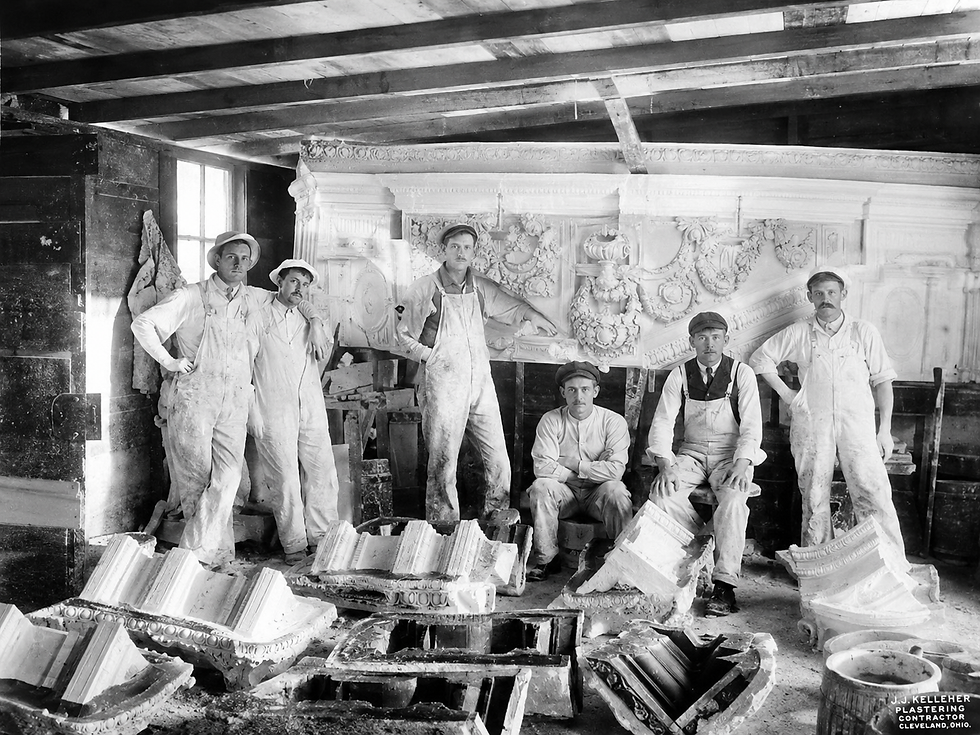
As photography began documenting the working trade, plasterers appear less as background figures and more as real crews: men in white work clothes, standing beside wagons, scaffolds, buckets, hawks, and trowels.


_________________________________________________________________________________________
Ornamental Plaster: The Art Above Us
Ornamental plaster moves from flat walls to architecture as artwork. Cornices, medallions, ceiling panels, and cast details require more than repair; they require pattern, patience, and an eye for what belongs.


___________________________________________________________________________________
What these images show, across centuries, is that plaster has always lived somewhere between structure and art. It protects, shapes, repairs, decorates, and preserves. Whether it appears in an ancient sculptor's studio, a fresco ceiling, a medieval building scene, a quiet painting, o r a black-and-white jobsite photograph, the work is still recognizable: hands, tools, material, patience, and skill.
At Olde World Walls & Ceilings, this is not a lost art we admire from a distance, it is the work we still proudly do!


